GPT-6.1 Terra is the volume model in the current OpenAI line. Sol is the one that sits next to Astra. Astra is the top. Terra is the one priced so a developer can run the same kind of job many times: read a pile of invoices, fill a form, mark up a drawing, draft the note that goes with it. OpenAI shipped it on October 26, 2026, in ChatGPT Work and Codex for Plus, Pro, Enterprise, and Edu, and on the API as gpt-6.1-terra.
It takes text and images and returns text. Amazon Bedrock lists a 1,050,000-token context and a 128,000-token max output. Artificial Analysis lists a 1 million token window. The work OpenAI points at is visual and operational: a technical drawing, a desktop app, a document, a video edit. The writing is part of the same claim. OpenAI describes it as clearer than GPT-5.6 Terra, the last Terra-class model.
The token price is the other half of the product. Standard API price is $1 per million input tokens, $0.05 cached, and $5 output. Sol is $2 and $10. GPT-5.6 Terra was $2 and $12. Cache writes are $1.25, half the previous Terra. Cached input is a quarter of what it was, $0.05 against $0.20. In ChatGPT Work and Codex, OpenAI says the same usage allowance covers more tasks than it did on GPT-5.6 Terra, and substantially more than on Sol or Astra. Bedrock's global rate matches the $1 and $5 price at or below 272,000 input tokens, and steps up above that. The in-region rate adds a fee on top of OpenAI's price.
Half the price, four points back
At max effort, Artificial Analysis scores Terra 48 on the Intelligence Index. That is 6 points above GPT-5.6 Terra, 4 points behind Sol, and 10 points above Luna. One index task at max costs $0.40, against $1.40 for GPT-5.6 Terra at max. Less than a third of the old Terra bill, for a higher score.
The setting you would reach for if you were buying the cheap model is not max. Low and medium are the ones on the cost frontier. High, xhigh, and max sit behind that line: you pay more per point than another model already on the chart. The gain over GPT-5.6 Terra is also larger down there, between 7 and 13 points, than the 6 points at max.
| Effort | Intelligence Index | Cost per index task |
|---|---|---|
| Low | 36 | $0.05 |
| Medium | 41 | $0.10 |
| High | 44 | $0.13 |
| Xhigh | 45 | $0.19 |
| Max | 48 | $0.40 |
On the same chart, Opus 5.5 is 58, Sonnet 5.5 and Muse Wonder Full are 56, Kimi K3.1 Pro is 55, and Astra and Gemini 4 Argon are 53. Sol is 52. Terra at max is a step behind Sol. Terra at medium, 41 for $0.10, is a different product from the number in a launch slide that used max.
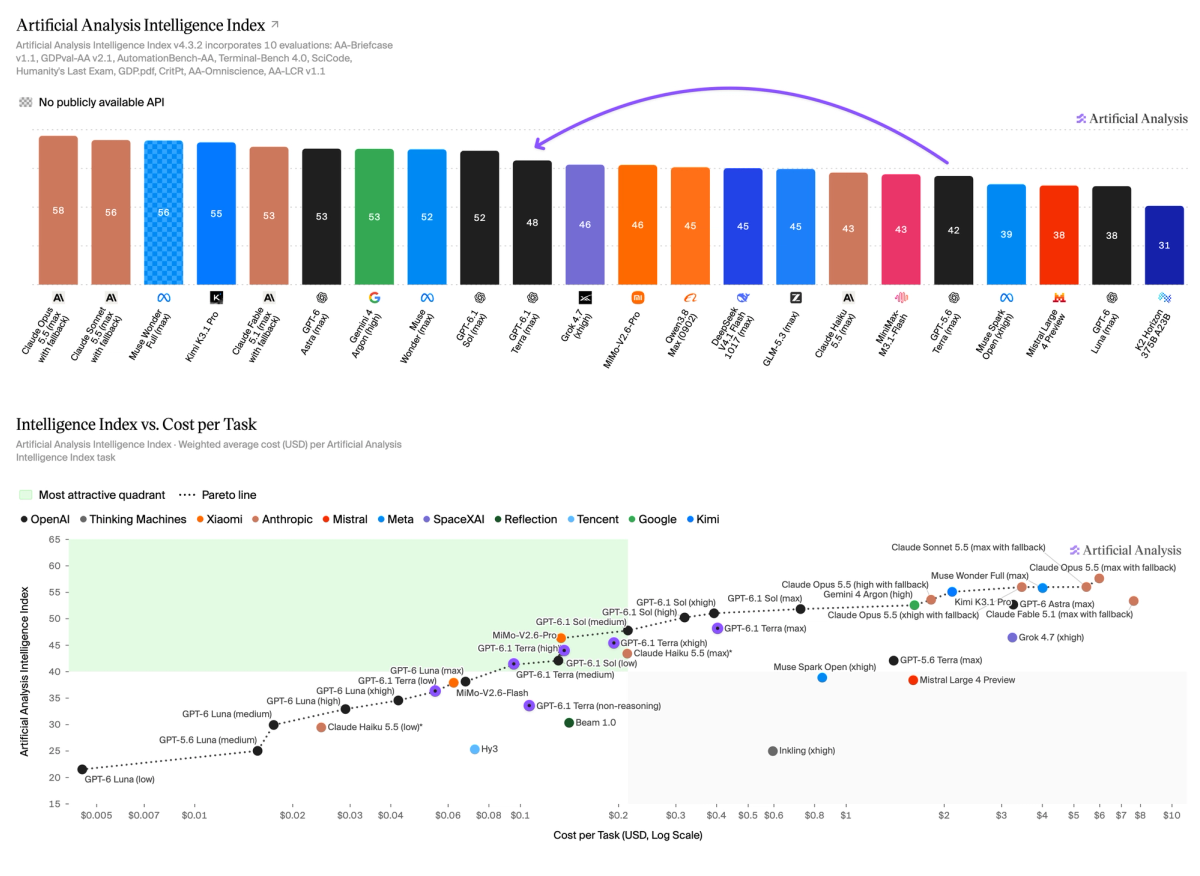
Artificial Analysis. Max is 48, four points behind Sol. On the cost chart, low and medium sit on the frontier. Max sits behind it.
The other 48 is a coding score
The Coding Agent Index v2.0 also scores Terra at 48. That index is FrontierCode, Terminal-Bench 4.0, and SWE-Atlas. It is not the Intelligence Index, even though the number matches. Terra's 48 on this one is in Codex. Sol in Codex is 54. Luna in Codex is 31. The Claude models on the same chart are in Claude Code. A Codex 48 does not pass a Claude Code score, and it does not mean the intelligence score and the coding score are the same result.
The frontier flips. On this coding chart, low and xhigh are the settings on the cost line. Medium, high, and max sit behind it. On the intelligence chart, low and medium were the frontier and xhigh was not. The cheap coding setting and the cheap general setting are not the same dial.
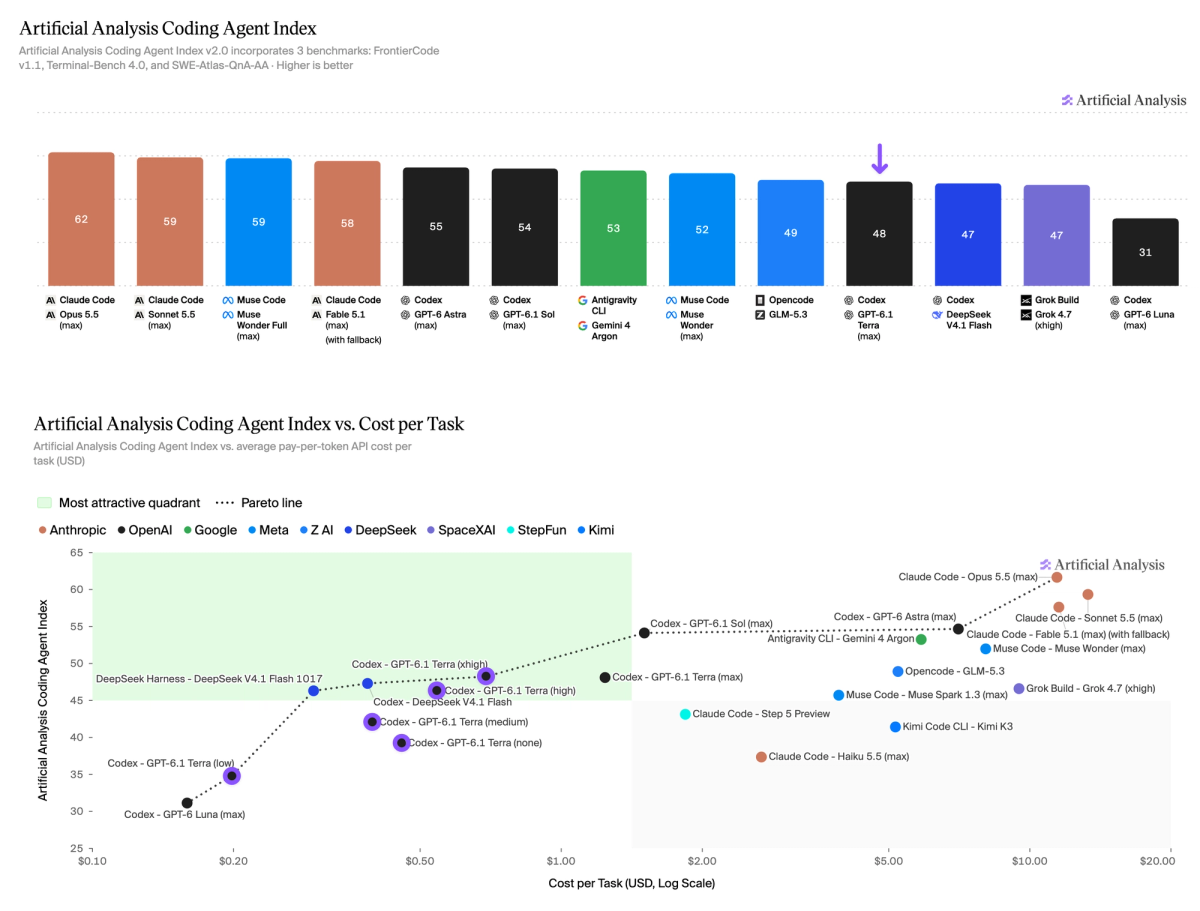
Artificial Analysis. Terra at max is 48 in Codex, six points behind Sol in Codex. Low and xhigh are the points on this cost frontier.
OpenAI's own coding line is narrower, and it agrees on the ranking. At max on OpenAI's Terminal-Bench 4.0, Terra solves 50.3% of tasks, more than double GPT-5.6 Terra's 21.5%. OpenAI says Sol and Astra remain the better choice for the hardest coding. On Terminal-Bench-Science 0.1, OpenAI says Terra at max passes Sol at lower cost and lands within five points of Opus 5.5 at less than a fifth of the estimated cost. Those are OpenAI's runs. They are not the Artificial Analysis chart.
On that chart, Terra's gain is about 20 points, level with Sol at max. Kimi K3.1 Pro leads it at 67%.
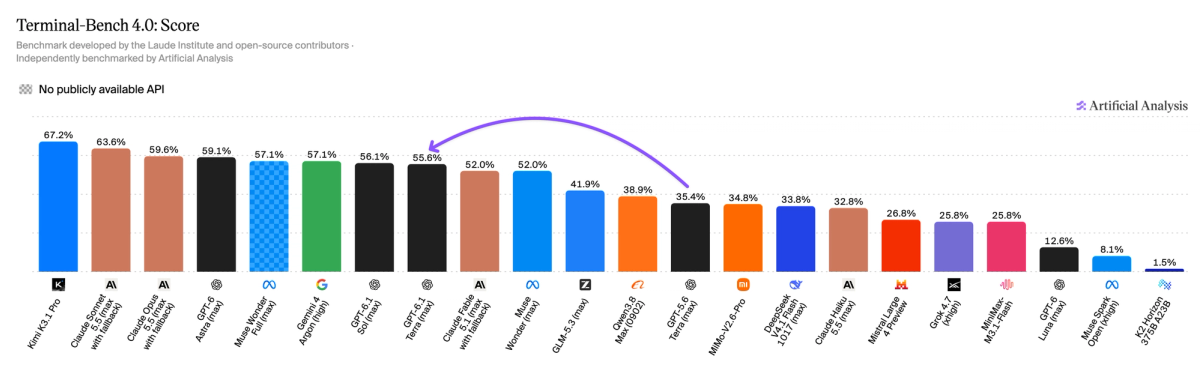
Artificial Analysis. Terra sits next to Sol. Kimi K3.1 Pro leads. GPT-5.6 Terra is well behind.
Computer use is the launch claim, and it is at medium
OpenAI's case for Terra is not the index. It is computer use: turn a drawing into a model, walk a desktop app, log a film shot by shot. The published comparison there is medium effort, on Agents' Last Exam. Terra scores 15 points above GPT-5.6 Terra at about a third of the cost, and OpenAI puts it on par with Astra at a tenth of the token price. At max, OpenAI says Terra uses a third of the tokens Opus 5.5 uses, or better, at a quarter of the price per token, which they combine into about a ninefold drop in cost per task. They also say the tasks finish more than three times faster than Astra and Sol.
The post does not print the Agents' Last Exam score under that 15-point gap. OSWorld 2.1, at medium, is described the same way: ahead of GPT-5.6 Terra's best score, at a fraction of the cost, with no percentage in the post. On MMMU-Pro, visual reasoning, Terra beats GPT-5.6 Terra at every effort OpenAI shows, and they say it nearly matches Astra and Sol. Again, no percentage in the post.
Treat that block as OpenAI's account of the job Terra is for. The independent number next to it is still the index: medium is 41 at $0.10, and that is the effort OpenAI used for the computer-use comparison.
It invents less, on two different tests
On AA-Omniscience, the hallucination rate falls from 88% on GPT-5.6 Terra to 38%. Accuracy rises 2 points. GDP.pdf, inside the index, moves 5 points. Most of the other index evals move less than Terminal-Bench.
OpenAI has a second factuality set, an internal one, built from prompts that tend to induce errors. At low effort the error rate falls from 53.6% to 16.7%. At max it falls 18 points, to 4.3%, which OpenAI puts next to Astra and Sol. That 4.3% is not the 38%. One is OpenAI's error set. The other is Artificial Analysis's rate of guessing when the model does not know.
OpenAI also says Terra is more likely than GPT-5.6 Terra to stay inside the task and to say when something is blocking it, and that it resists prompt injection in their tests. On cybersecurity it meets the Critical threshold in OpenAI's Preparedness Framework, with the same class of protections as Astra. That is a classification, not a how-to.
In practice
- Call gpt-6.1-terra when the job is repeated computer use and document work, and the token price matters. The list price is $1, $0.05 cached, and $5. Cache writes are $1.25. Sol remains $2 and $10.
- Use medium for the computer-use claim OpenAI is making. That comparison is 15 points over GPT-5.6 Terra at about a third of the cost. Medium on the index is 41, at $0.10 a task. Low is 36, at $0.05. Those two are the ones on the intelligence-cost frontier.
- Read max as 48, four points behind Sol, at $0.40 a task. That is 6 points above GPT-5.6 Terra and less than a third of that model's $1.40 task. High is 44 at $0.13. Xhigh is 45 at $0.19. On the intelligence chart, those three sit behind the frontier.
- On coding agents, split the dial. Low and xhigh are the frontier settings on the Coding Agent Index. Terra's 48 there is Codex, six points behind Sol's 54 in Codex. OpenAI's own Terminal-Bench at max is 50.3%, against 21.5% for GPT-5.6 Terra. Artificial Analysis puts Terra next to Sol, with Kimi K3.1 Pro at 67% ahead of both. For the hardest coding, OpenAI still points at Sol and Astra.
- Keep the factuality numbers in their own tests. Omniscience hallucination is 38%, down from 88%, with accuracy up 2 points. OpenAI's internal error rate is 16.7% at low and 4.3% at max.
- A long prompt on Bedrock changes the price. At or below 272,000 input tokens, the global rate matches OpenAI. Above that, Bedrock steps up. The context Bedrock lists is 1,050,000 tokens, with 128,000 tokens of max output.
Sources: Introducing GPT-6.1 Terra, Artificial Analysis, and the Bedrock model card. The index ladder, the $0.40 task, the Coding Agent Index, the Omniscience rates, and the Terminal-Bench chart are Artificial Analysis. The $1 / $0.05 / $5 price, the Agents' Last Exam comparison, the 50.3% Terminal-Bench, Terminal-Bench-Science, MMMU-Pro, OSWorld, and the internal error rates are OpenAI's. The 1,050,000-token window and the Bedrock price step are AWS.