Kimi K3.1 Pro is the first model in Moonshot's K3.1 series, and it is a post-trained Kimi K3. The architecture story Moonshot tells is not a new base model. It is more reinforcement learning, across coding, tools, and long jobs, on top of K3. They call it their most capable 3T-class model so far. Artificial Analysis lists 2.8 trillion parameters in total and 104 billion active, with a 1 million token window, text and image in.
You can call it now. It is on Kimi.ai, the mobile apps, Kimi Work, Kimi Code, and the API as kimi-k3.1-pro. There is a second endpoint, kimi-k3.1-pro-highspeed, which Moonshot says runs at two to three times the speed, for shorter back-and-forth. That fast endpoint does not have its own index score. The weights, the file for running it yourself, are promised by November 4. Until that file is public, the product is the API.
Moonshot's own score table is at max effort, with temperature 1.0 and top-p 0.95. The independent comparison below is Artificial Analysis's launch measurement, set next to K3 at max.
Fourth place, and the bill did not move
K3.1 Pro scores 55 on the Intelligence Index. That is fourth. Opus 5.5 at max with fallback is 58. Sonnet 5.5 at max with fallback and Muse Wonder Full at max are 56. K3 at max is 44. The gain is 11 points.
An index task costs $1.98. K3's task is $2.00. The token price fell by a third, to $2 per million input tokens, $0.20 cached, and $10 output. Output per task rose 14%, from about 48,000 tokens on K3 to about 55,000. A cheaper token and a longer answer land on the same invoice. The thing that changed is the score.
Artificial Analysis says that once the weights ship, this becomes the highest-scoring open model on the index, and the gap from the leading proprietary score narrows from 12 points to 3. That sentence is about the file. It is not true of a download today.
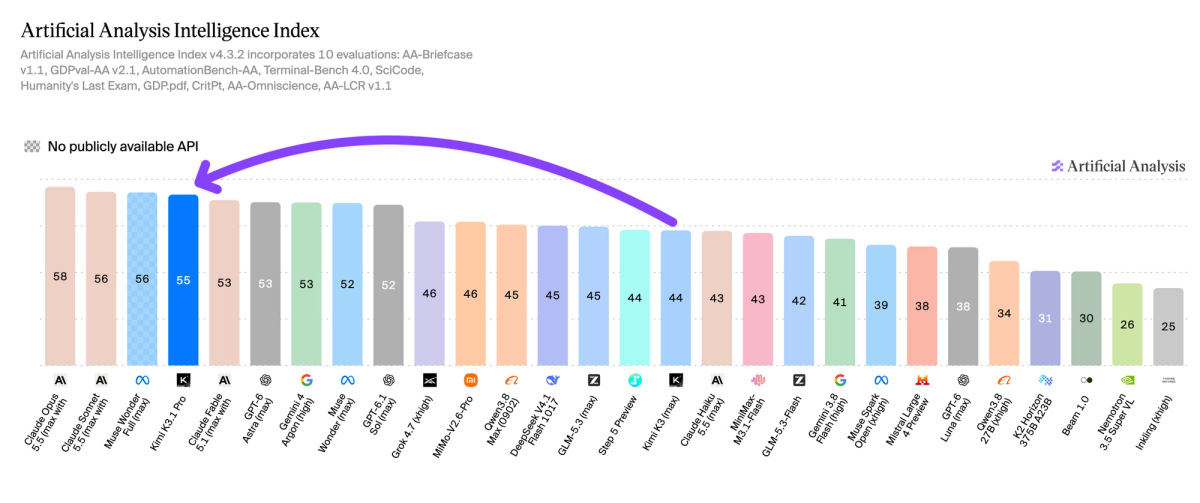
Artificial Analysis. K3.1 Pro is 55, behind Opus at 58 and behind Sonnet and Muse Wonder Full at 56. Kimi K3 is 44.
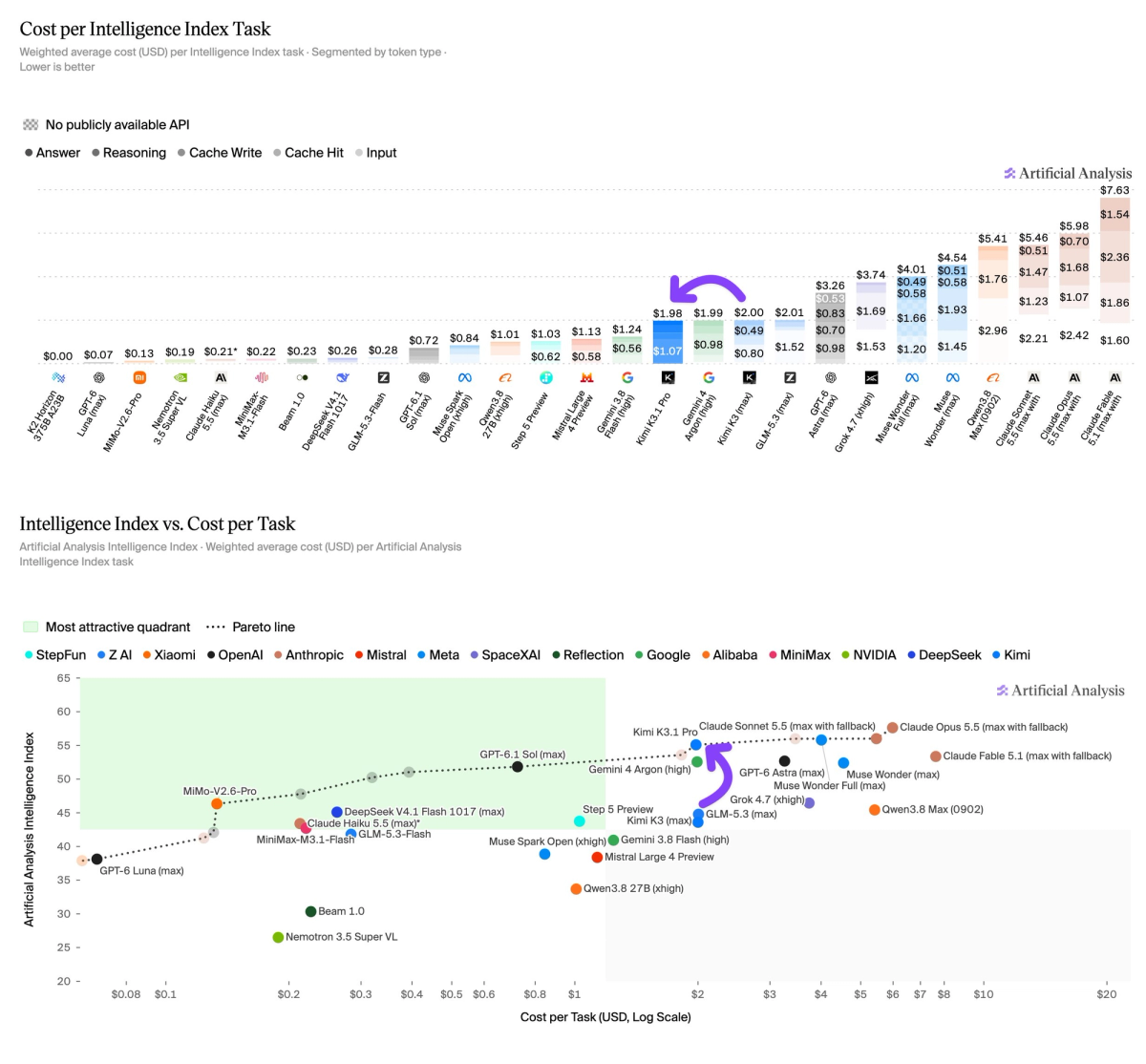
Artificial Analysis. K3.1 Pro is $1.98 a task. Kimi K3 is $2.00. The score is 11 points higher at the same bill.
Where the 11 points came from
They came from agents, not from a broad jump on every knowledge test.
On Terminal-Bench 4.0, Artificial Analysis scores 67%, up from 13% for K3, ahead of Sonnet 5.5 at 64%. On AutomationBench-AA, the score goes from 58% to 73%. On GDPval-AA, K3.1 Pro is third at 1,846 Elo, up 312 from K3, behind Opus 5.5 at 1,866 and Muse Wonder Full at 1,857. That is the band just under the two models at the top of the knowledge-work chart.
The rest of the index moves less. Humanity's Last Exam goes from 47% to 52%. CritPt goes from 23% to 25%. SciCode goes from 59% to 61%. AA-Omniscience goes from 20 to 30. Hallucination falls from 53% to 44%. Accuracy rises from 48% to 51%. The model knows a little more and invents a little less. It does not catch the models that lead Omniscience.
Moonshot's own Terminal-Bench, run in the Claude Code harness, is 65.7%. They put that ahead of an Astra figure of 58.2% and just behind an Opus figure of 66.4%. That table mixes their run with other labs' published scores. It is not the 67%.
What Moonshot built it to do
The launch post spends its length on three jobs: long coding, 3D, and finance.
On coding, Moonshot describes work that runs from a fix in an existing repo to a full project, including games and web apps, with the model driving tools rather than only completing a function. Their internal long-horizon coding bench, Kimi Code Bench 3.0, goes from 55.95% on K3 to 61.2%. That bench is theirs.
On 3D, the claim is that a text brief, a sketch, or a reference image is enough to get a usable model, and that the model can write and run Blender or CAD scripts without an MCP connector. On BenchCAD with tools, they report 92.7%, against 96.2% for Opus 5.5 and 95.9% for Astra. The open models in that comparison were scored by Moonshot on a 1,000-case sample of a 17,900-case set. The Opus and Astra figures are taken from those labs' reports. 3D Make, the viewer on kimi.ai, is the product surface for this, not a benchmark.
On finance, they report 64.4 on OfficeQA Pro v2, which is retrieval and arithmetic over real documents. Their internal set moves by deltas rather than by a public score: financial modeling up 7.2 points on K3, financial research up 11.6, and a business-operations simulation at about 4.2 times K3. On their own hallucination stress test, the claim-level error rate falls from 23.4% on K3 to 8.3%. Moonshot says that test is built to provoke mistakes, and that 8.3% is not the error rate of an ordinary day. It is also not the Omniscience 44%.
The open-weight release has a separate constraint. Moonshot says cyber-related data was taken out of mid-training and out of the reinforcement-learning mix before that file is published, and that the open model's cyber capability stays behind frontier proprietary models already on the market. The API available today is not that file.
In practice
- Call kimi-k3.1-pro for the model Artificial Analysis scored. The fast endpoint is kimi-k3.1-pro-highspeed, at the two to three times speed Moonshot quotes. It does not have a separate index.
- Read the 55 as fourth, 11 points above K3 at max. Opus is 58. Sonnet and Muse Wonder Full are 56. The weights are dated November 4. The download is not the thing you can pin today.
- Budget the task at $1.98, next to K3's $2.00. The token price is a third lower, at $2, $0.20 cached, and $10. The answers are about 14% longer, near 55,000 output tokens a task. Moonshot's published table uses max effort.
- On agents, use Artificial Analysis's Terminal-Bench at 67%, up from 13%, ahead of Sonnet at 64%. Moonshot's Claude Code run is 65.7%. GDPval at 1,846 Elo is third, behind Opus at 1,866 and Muse Wonder Full at 1,857. AutomationBench-AA goes from 58% to 73%.
- On knowledge, expect a smaller move. Omniscience goes from 20 to 30. Hallucination goes from 53% to 44%. Accuracy goes from 48% to 51%. Moonshot's 8.3% is their stress test, not this one.
- Keep BenchCAD at 92.7% and OfficeQA Pro v2 at 64.4 in Moonshot's column, with the sample and the harness they name. The 55, the $1.98, and the 67% are Artificial Analysis.
Sources: Introducing Kimi K3.1 Pro and Artificial Analysis. The index of 55, the $1.98 task, the 55,000 output tokens, Terminal-Bench at 67%, AutomationBench-AA, GDPval at 1,846, and the Omniscience rates are Artificial Analysis. The API ids, the $2 / $0.20 / $10 price, the November 4 weights, the 65.7% Terminal-Bench, BenchCAD, OfficeQA, and the internal deltas are Moonshot's. The 2.8 trillion total and 104 billion active parameters are Artificial Analysis.
