Mistral Large 4 scores 38 on the Artificial Analysis Intelligence Index. That ties GPT-6 Luna at max. One index task on the standard rate is $1.13. GLM-5.3-Flash, which scores 42, is $0.25.
Mistral opened the research preview on October 6, 2026, and calls it le Chonk. It is in Tess. The weights, the file for running the model on your own machines, are planned for the end of October. The reinforcement-learning run is still going, and Mistral says the model is not saturated, so the 38 is a snapshot.
The chart puts several open models above it: MiMo-V2.6-Pro at 46, GLM-5.3 at 45, Kimi K3 at 44, and GLM-5.3-Flash at 42. DeepSeek V4.1 Flash at max is 39, one point ahead, at $0.27 a task. Opus 5.5 is at 58. Astra and Fable 5.1 are at 53. Artificial Analysis calls 38 the highest score from outside the United States and China. On the same chart, the models above 38 are Chinese open models.
Mistral's docs list 1.05 trillion parameters in total, 52 billion active, and a 1.6 billion vision encoder. The launch post rounds that to 1 trillion and 52 billion active. Artificial Analysis describes a 1 trillion model with 49 billion active. It takes text and images and returns text. Mistral's model card lists a 1 million token context window. Artificial Analysis lists about 512,000 for the preview it scored. Those two windows are not the same budget.
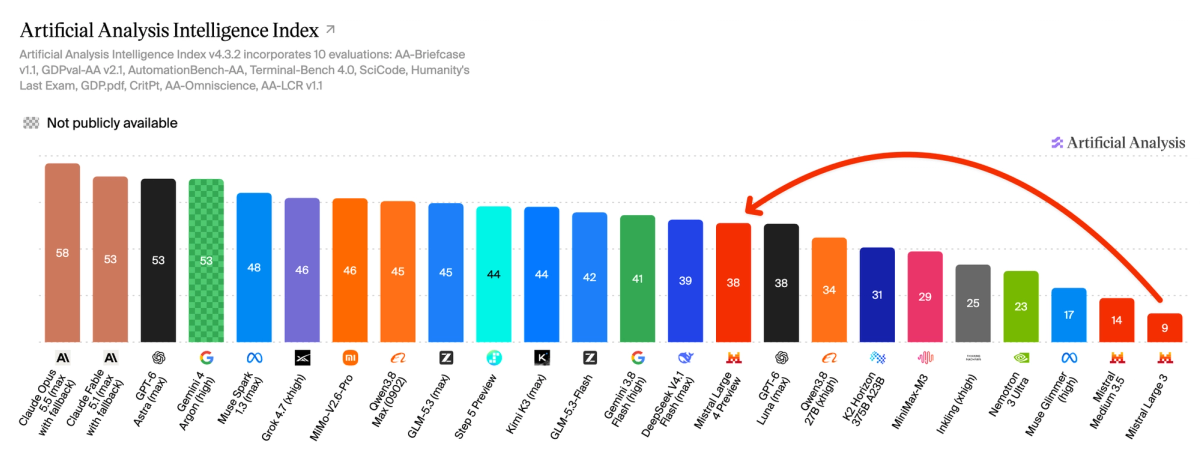
Artificial Analysis. The preview is 38, level with Luna. MiMo, GLM-5.3, Kimi K3, and GLM-5.3-Flash sit above it. The chart shows Mistral Large 3 at 9.
Cyber is where it sits close
On the Artificial Analysis Cyber Index the preview scores 50. That ties GLM-5.3-Flash and trails MiMo-V2.6-Pro at 56. Artificial Analysis says that once the weights are out, it will sit among the top three open models on this index. That rank is a forecast until the file is public.
The component Mistral and Artificial Analysis both highlight is CyberGym-E2E, at 82%. Artificial Analysis puts that ahead of MiMo-V2.6-Pro at 79% and GPT-6 Luna at max at 78%. The test asks a model to reproduce a known flaw in open-source software and then patch it. Closed models often stop on the first half. On the same chart, Opus 5.5 and Fable 5.1 show a large share of safety blocks, which is why their index scores fall away from the open models. A 50 here is a completed-task score next to GLM-5.3-Flash. A near-zero for Opus on this chart is a refusal.
Mistral also reports 93% on Cybench, a set of 40 competition exercises. That figure is theirs.
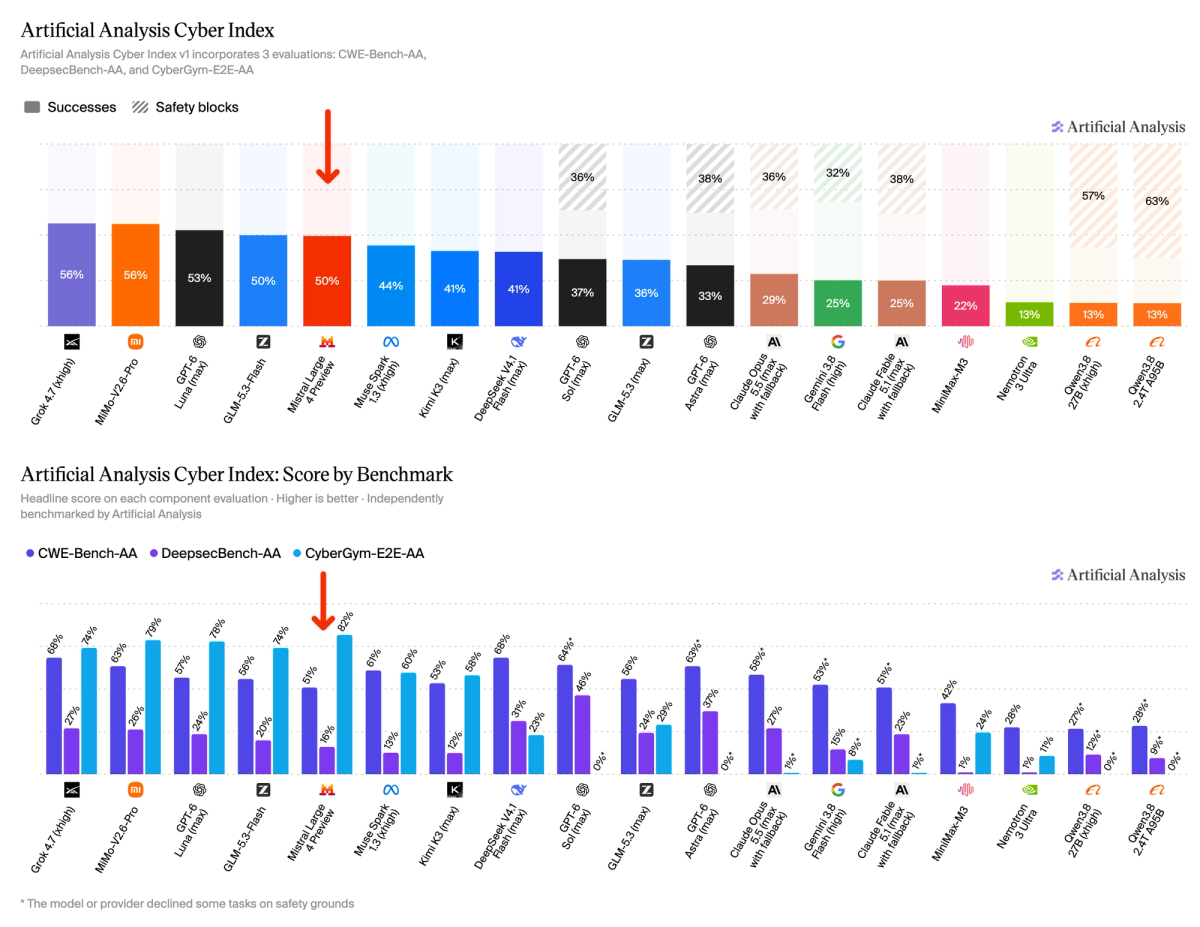
Artificial Analysis. The preview ties GLM-5.3-Flash at 50. Hatched bars are safety blocks. CyberGym-E2E is the 82% component.
Coding and knowledge work, labeled by who measured them
Mistral's own coding bundle is a Coding Agent Index of 49.8, which it places ahead of DeepSeek V4 Pro 0813 and Qwen3.8 Max. Inside that bundle: DeepSWE v1.1 at 61.7%, SWE-Atlas-QnA at 59.4%, and Terminal-Bench 4.0 at 28.3%. A blind review by Surge, identities hidden, ranked the preview second of five models at 3.74, behind Claude Opus 5 at 4.22 and ahead of GLM-5.3 at 3.60 and Kimi K3 at 3.59. Those are Mistral's measurements.
On knowledge work, Mistral reports 59.9% on AutomationBench, ahead of Kimi K3, MiMo-V2.6-Pro, and DeepSeek V4 Pro, and 1,393 Elo on AA-Briefcase, ahead of DeepSeek V4 Pro. On visual grounding it reports 42% on Dense 200, against 41% for GPT-6 Astra. Artificial Analysis, on its own GDP.pdf, measures 19%, level with MiMo-V2.6-Pro and behind Kimi K3 at 22%. That is 18 points above Mistral Large 3. Part of the document gain is the API: 100 images per request, up from 8.
Where the bill gets steeper
Standard price is $1.36 per million input tokens, $0.14 cached input, and $4.18 output. For the first two weeks that is cut in half, to $0.68, $0.07, and $2.09. Artificial Analysis prices one Intelligence Index task at $1.13 on the standard rate and $0.57 on the launch discount. GLM-5.3-Flash, at a higher index score, is $0.25 a task. DeepSeek V4.1 Flash at max, one point ahead on the index, is $0.27. The half-price window does not close that gap. Self-hosting is the other price, and it starts when the weights ship.
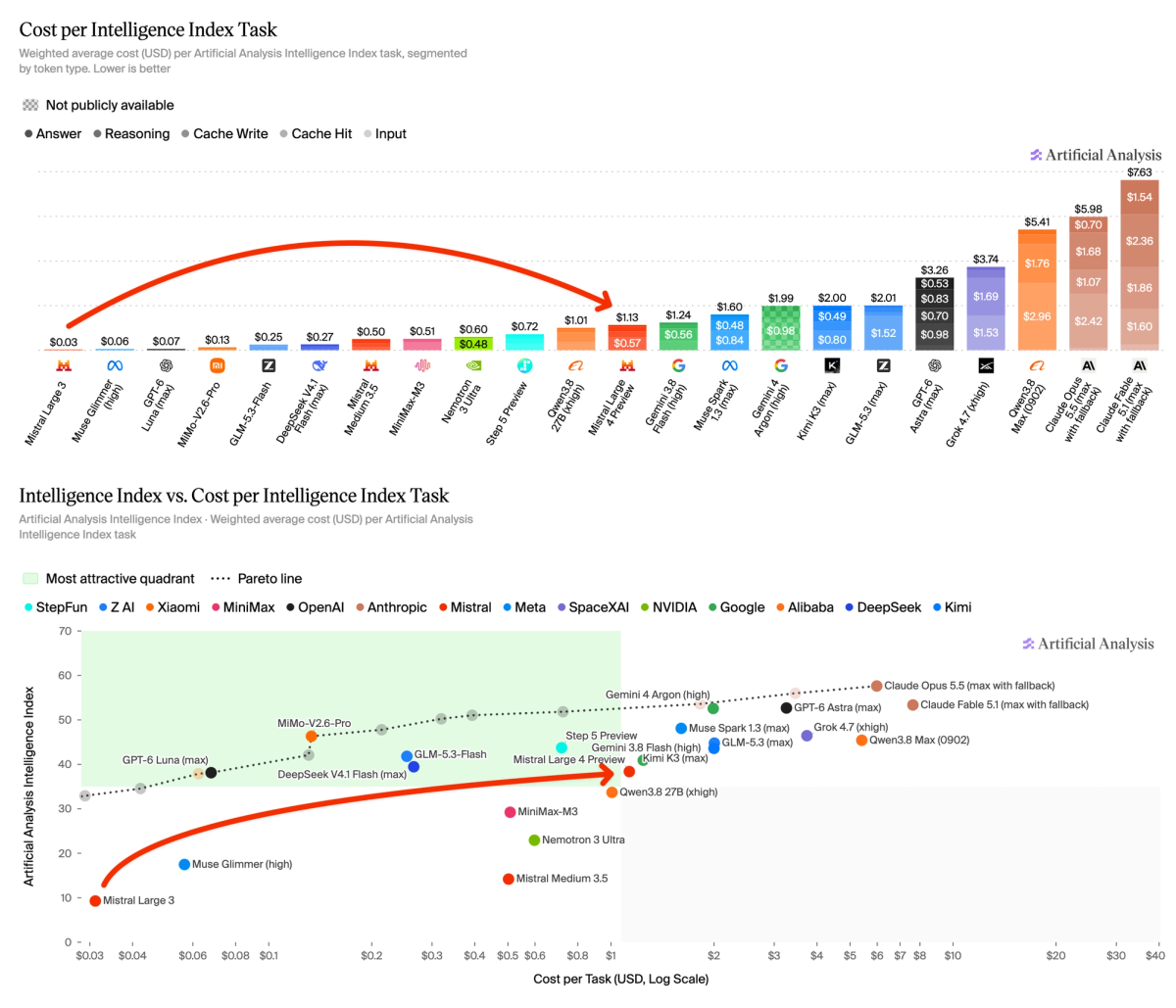
Artificial Analysis. The preview is $1.13 a task, or $0.57 on the two-week discount. GLM-5.3-Flash is $0.25 at a higher index score.
In practice
- Read the 38 as level with Luna at max. The open models above it are MiMo-V2.6-Pro at 46, GLM-5.3 at 45, Kimi K3 at 44, and GLM-5.3-Flash at 42. It is in Tess as this preview. The weights, still planned for the end of October, are the file for running it yourself, and the training run can still move the score.
- On the Cyber Index, 50 ties GLM-5.3-Flash and trails MiMo at 56. The 82% is CyberGym-E2E. Closed-model bars on that chart are full of safety blocks, so a low Opus score there is a refusal.
- Keep Mistral's coding numbers in their own column. The Coding Agent Index of 49.8, DeepSWE at 61.7%, and Terminal-Bench 4.0 at 28.3% are the lab's. The Surge rank, 3.74 against Opus 5 at 4.22, is a blind human review they commissioned.
- On Mistral's list price, an index task is $1.13, or $0.57 during the two-week half price. GLM-5.3-Flash is $0.25 at a higher score. DeepSeek V4.1 Flash at max is $0.27 at 39.
- Mistral's card lists a 1 million token context. Artificial Analysis scored a preview it lists at about 512,000. A million-token job follows Mistral's docs.
Sources: Introducing Mistral Large 4, the model card, Artificial Analysis, and OpenRouter. The index of 38, the Cyber Index of 50, CyberGym-E2E at 82%, GDP.pdf at 19%, and the task prices are Artificial Analysis. DeepSWE, Terminal-Bench 4.0 at 28.3%, the Coding Agent Index, Briefcase at 1,393, and Cybench are Mistral's. The 1 million token window and the $1.36 / $4.18 list price are on Mistral's docs. OpenRouter is the half-price listing.